
The Computer For The 21st Century, Revisited
Can Adaptive Software act as a harness for your attention?

I’m on a journey to deep dive into the history of Ambient Computing and Adaptive Software, and so together with AI I curated a set of canonical works. Shoulders of giants, etc. Part of this motivation is to be able to study and understand what attempts didn’t work, and why. What can I learn from them to not repeat the same mistakes? Some of this is of course excavation, archeology and hypothesising, but valuable nonetheless.
The first piece to tackle is “The Computer For The 21st Century” by Mark Weiser, published in 1991.
My TLDR of it:
Computers trap you within the device itself. It’s frustrating and disruptive to your work because the device, while connected to the internet, is disconnected from context, your surroundings and any general awareness. The solution to this is ubiquitous and calm computing that disappears into the background and the objects around you, and this will be the computer of the future.
The paper paints a beautiful and idealistic world where computers just blend in, and don’t frustrate or distract us. All based on real physical device and software experiments executed at Xerox PARC.
The thing I found shocking, but not surprising, is that the author could see where usage patterns of personal computing were going. It really is forward-looking and deep. He identified problems with computing that still exist today, pointed out what was wrong and built an alternative.
Yet 30 years later, not only did the world not correct, it actually doubled down with mobile phones repeating the same patterns that he called to avoid. And where the author flagged frustration with computers in the 90s, I think in current times this is echoed as problems with attention, and exploitative attention-grabbing computing in the rise of mobile phones and social media. To clarify, the paper didn’t mention attention, that is me extending the concept. So, we still have these boxes that are connected to the internet, but disconnected from us, our surroundings and from what we care about right now at this moment.
What bugs me about it is “why?”. If their experiments proved a superior way of working, how come it never propagated into the mainstream?
It’s not often that the problem in these situations is a singular reason, or a big technical gap. The author cites what was at the time the best in class capabilities of compute, a fraction of what we have today. With them they were able to produce working devices and software, and predicted that they would be able to maximise it with further performance improvements.
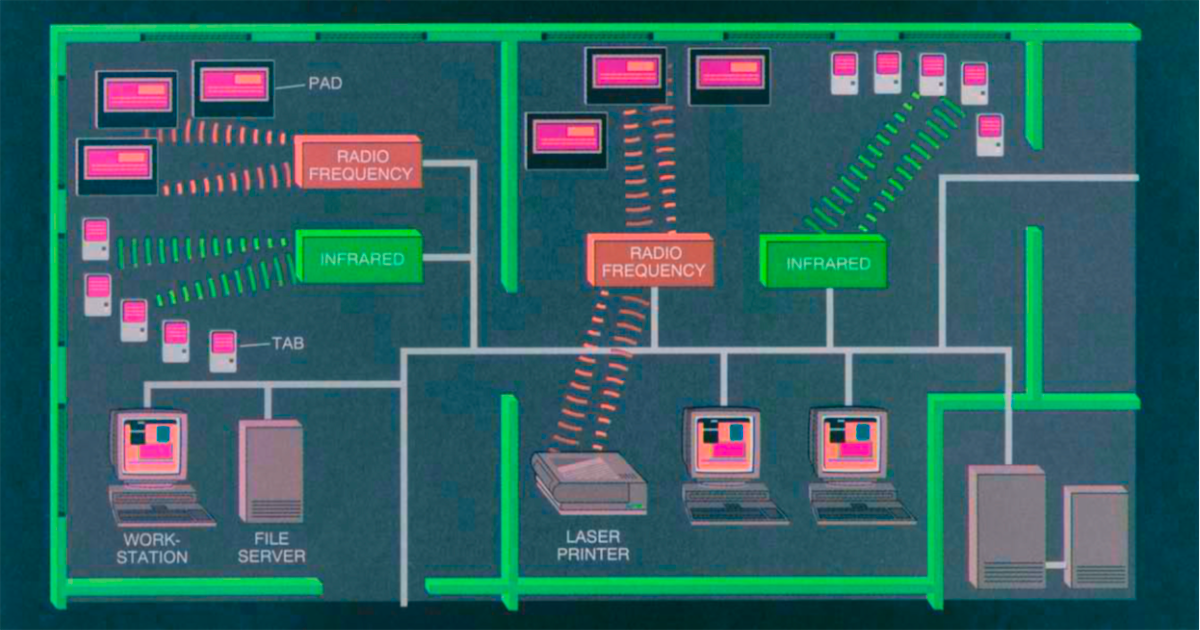
I hypothesise that the problem was that the attitude was too extreme. The offer of ubiquitous and calm computing in theory can sound very enticing. It sounds like a utopian world. I don’t think it’s realistic and I think it denies things we have discovered about our nature and our brain.
A quote I loved is:
There is more information available at our fingertips during a walk in the woods than in any computer system, yet people find a walk among trees relaxing and computers frustrating.
Trying to interpret this for 2026: A walk in the woods floods your senses with more information than any computer system could. Light, sound, movement, temperature, the shape of every branch. Yet 35 years later, a walk in the woods is still considered a healthier activity than doomscrolling your phone.
Analysts like Ben Thompson or investors like Rory O’Driscoll from USV claim things like “people don’t want to work, people want to be entertained” (my paraphrasing). This is the second extreme and is mostly true for consumer software. The constant distraction and dopamine hits. On the other hand, we don’t normally associate professional software with entertainment, yet all these prompt boxes are super effective as entertainment-brain invading work tools. Slot machines in a casino-shaped factory.
Every now and then we see new devices which promise to be calm and disconnect us, with no notifications or distractions. It’s nice, but I think it’s a knee-jerk reaction and overcorrection to the over-exaggeration and over-attention-grabbing of the common devices and platforms. I also suspect that they will never be mainstream because they are denying the lizard brain, and the pleasures or the satisfaction that we can feel. People don’t buy calm. Yes, you can buy calm in the way of a nice spa, but you don’t want to live in a spa.
So the calm and ubiquitous computing leans into our patterns of familiarity, and objects disappear into the background, to the point where we are denying pleasure from the lizard brain. And the entertainment side leans into fucking getting bulimia from TikTok, and denies us the required focus and rest.
Both are denying a reality about ourselves and if we want any kind of computing to be mainstream but beneficial, we mustn’t completely ignore either side of our nature.
Could we exploit the exploitable mechanisms in a controlled, productive and beneficial way, and can we use computing and software to referee this?
If computing and software truly become ubiquitous, understanding the context in the space that we’re at, how can we make them give a balanced mode of triggers and rewards and dopamine, but also not freak us the fuck out?
Can we help it understand who we are, where we are, what we’re working on, what we care about and what’s the most important thing right now? I believe we can.
If we can communicate this to the computers, we can exploit but not abuse mechanisms. Gamification works for a reason. Triggers and attention-grabbing work for a reason. Use them wisely.
It’s my belief that Adaptive Software can bring this balance. Adaptive software can know what you care about most, and use gratifying and effective mechanisms to channel your attention to the things that you care about most, whether it’s work or leisure. And the rest can be calm. It won’t deny the important things that are happening in the background or being taken care of by the system. You will know they are there because you are made aware of them. Yet they’re not grabbing your attention when it’s not aligned with you or with the goals that you stated.
Where the paper presents an idealistic view that suits artists, researchers, and artisans, Adaptive Software can become mainstream as a harness for your attention.
AI has made software production cheap, and that means that we no longer have to think of what is best for everyone, but can consider what is best for every individual. The decreasing cost of software and the ability of agents to reason in real time is what makes this possible now. Have the user communicate to you what they care about, and let the software reason in real time to decide what actions and information should grab attention and hit that dopamine, and what should be calm.
The infrastructure we are building at Sky Valley Ambient Computing makes this possible. It enables divergence of versions per user, guided by an agent that is aware of behaviour, usage history, preference, purpose, and has the ability to shape your individual experience accordingly. Guided by your goals, carried over to all software in the network.