
Permanently Unfinished
On generative music, the black box, and software that grows

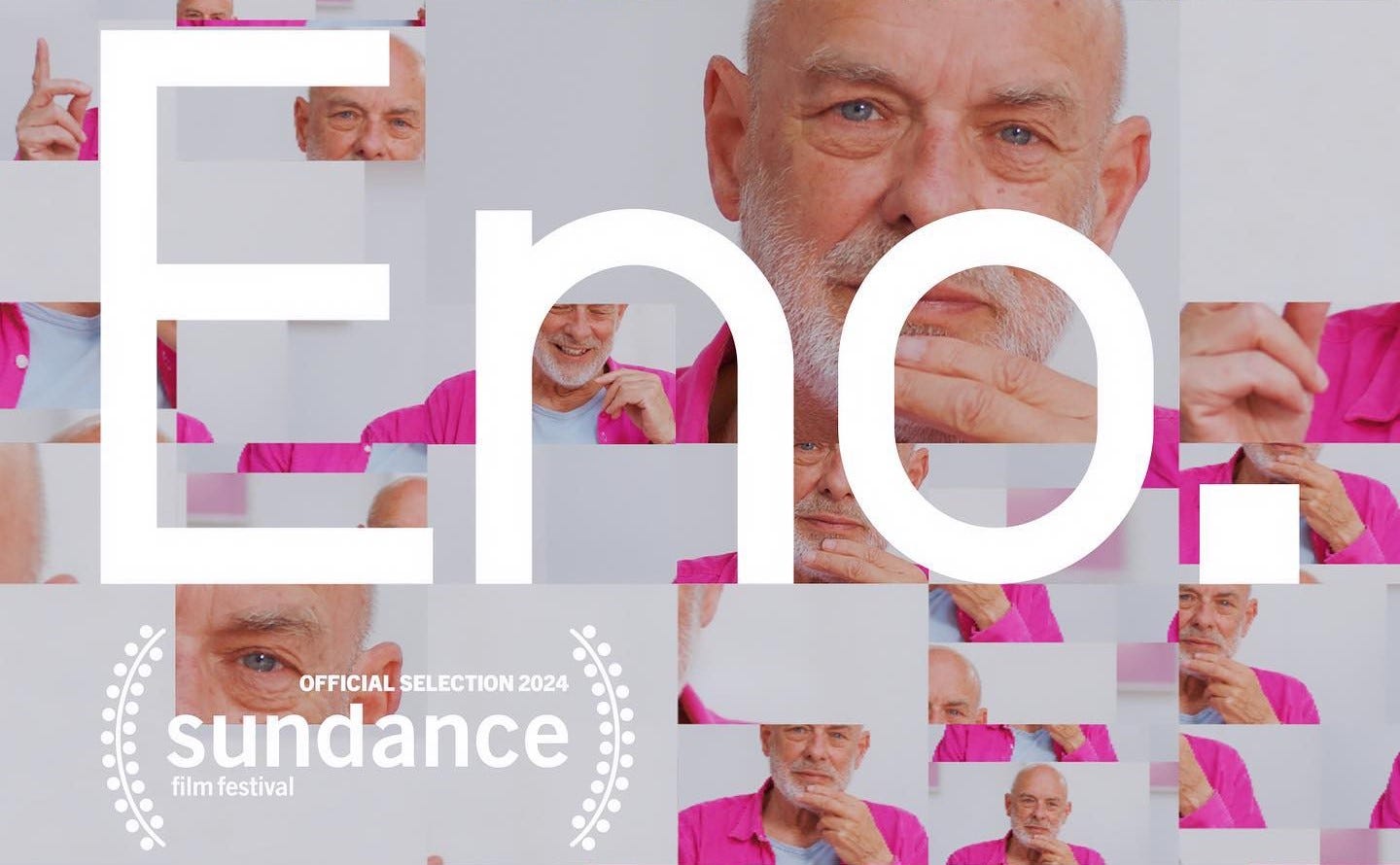
Two people watch the Eno documentary in the same week and compare notes. The opening is the same. The closing is the same. In between, the films they saw are not. Scenes unfold in different orders. Music appears in one version that the other person never hears. Entire passages of Eno’s life surface in one viewing and disappear in another.
This is not a glitch. Gary Hustwit’s 2024 documentary about Brian Eno was built to work this way. A piece of software called Brain One sequences 500 hours of footage from Eno’s archive differently every time the film runs. The New York Times estimated 52 quintillion possible versions. That’s more than five times the number of grains of sand on earth. There will never be a director’s cut, Hustwit has said, because the director’s cut is the system.
For anyone who knows Eno’s work, the film is not a novelty. It is a conclusion.
In May 1995, Wired published a long interview with Eno, conducted by Kevin Kelly over several months of conversations. Eno was working with a piece of software called Koan that had brought him closer than anything before to what he’d been trying to build for two decades. He was thinking carefully about what that thing was.
Kelly asked him to imagine music twenty years in the future. Eno said that what musicians would sell was not pieces of music but systems. Tools by which people could shape their own listening experiences. Musicians would offer what he called unfinished pieces: raw material with a strong character already, but open at the edges.
Then Kelly asked whether that was what people meant by interactive music.
Eno said no. Interactive, he argued, implies hands on controls. A game. A user intervening in something otherwise complete. That wasn’t what he meant. In a blinding flash of inspiration, he said, he had recently arrived at the right word.
Unfinished. Not as a temporary state, but as a permanent condition. Think of cultural products, or artworks, or even people, as permanently unfinished. We assume that things have a fixed nature. A piece of music, once made, is what it is. He thought this was wrong. The functional identity of a thing is a product of its interaction with the world. It becomes what it is in context, not before.
This was a philosophical claim, not just a design preference. And it was not only about music.
The model he was reacting against had a specific origin date. Before 1877, every musical experience was unrepeatable. You heard music because someone was playing it, in a room, at that moment. Thomas Edison’s phonograph changed that: a performance could be captured, reproduced, owned. You could hear the same thing identically, any time, anywhere. This was an advancement.
Eno thought something was also lost.
He was a nervous flyer. In the late 1970s, passing through airports, he kept noticing the background music. Not because it was bad, but because of what it did to a room. It imposed. It had a mood and applied that mood to the space regardless of what the space needed. He wanted something that could accommodate a room rather than colonize it. Music that could be, as he wrote in the liner notes to Music for Airports, “as ignorable as it is interesting”.
A finished recording couldn’t do this. It arrived with its character fully formed. It was made somewhere else, at a particular moment, and it would be exactly that thing every time you played it.
What the airport needed was something permanently unfinished.
The problem was that building such a thing required solving two separate problems simultaneously, and neither had an obvious solution.
The first was technical. Eno had been working on it since at least 1975. Music for Airports was built from tape loops of different lengths each containing a single recorded note, running on separate machines. Because the lengths were mathematically incommensurable, the loops never quite came back into sync. For any practical purpose, the music was non-repeating. A genuinely generative system: set it running and it would produce music indefinitely, never quite the same twice.
He wasn’t working alone. Steve Reich had done something similar ten years earlier. His 1965 composition It’s Gonna Rain used two tape machines playing identical loops at fractionally different speeds, slowly phasing apart, a continuously shifting soundscape from the simplest possible materials. Terry Riley’s In C, from 1964, was built from 53 melodic patterns played by a variable number of musicians with no fixed duration. Both were generative in a mechanical sense.
But for Reich and Riley, the variation was a byproduct of the process. The process was the point; the demonstration of what happens when you set certain rules in motion and step back. Eno absorbed both and took them somewhere different. He wanted the variation to serve something: the fit to the room, the accommodation of the listener, the permanently unfinished quality he was struggling to articulate. The distinction between variation as byproduct and variation as intent is what separates his project from his predecessors.
The second problem was logistical. You couldn’t ship the system. Music for Airports was a living process, but there was no mechanism to deliver a living process to a listener. So Eno recorded its output and pressed it to vinyl. The finished artifact won by default.
He said in interviews that what he wanted was to sell the system itself, so the listener would know the music was always unique. He just couldn’t.
SSEYO, a small British software company, had built a generative music engine that let a composer set 150 parameters and leave the computer to improvise within them. As Eno put it, “the way wind improvises a wind chime.” For the first time the system was software, which meant in principle it could be distributed as software. He published twelve pieces made with it on a floppy disk in 1996 under the title Generative Music 1.
The distinction became live music: always different, trapped in time and place. Recorded music: free of time and place, always identical. Generative music: always different and free of time and place. The third category finally had a working example.
Then SSEYO was acquired. The technology went dark.
Eno kept working.
In the same interview, Kelly asked him: if you could have a black box that could do anything, what would it do?
He didn’t hesitate. He wanted a box that makes choices about its own outputs and that could evaluate what it produces, reinforce what works, feed results back in. Not a box that executed instructions, but one that encoded taste. A system that stood in for his judgment rather than carrying out his specifications.
He made it concrete with an image. In the future, he said, you wouldn’t buy a Shostakovich recording. You’d buy a Shostakovich box - a system that generates new music in the manner of Shostakovich, guided by a model of how Shostakovich chose. You could buy a Brian Eno box. What the musician would be selling was not pieces of music but a way of looking at things.
This was a more radical version of the permanently unfinished idea. Not just output that varies, but a system that learns from its own variation. A grower, as he called it in a separate interview that year, something that generates forward from what it discovers rather than replaying what it was told.
None of the systems he built could do this. They varied. They didn’t evaluate. They generated; they didn’t learn. The loop he described remained open.
Peter Chilvers, a Cambridgeshire musician and software designer, solved half the remaining problem. Working with Eno, he released Bloom for iPhone in 2008. The App Store provided what no previous format had: a mechanism to ship the generative engine itself, running in someone’s pocket, rather than a recording of its output. Reflection in 2017 went further — an app that produces an endless stream, the album replaced entirely by a process.
What Eno had been trying to distribute since 1975 was now a four-dollar download. One problem, solved.
The black box was still missing.
The 2024 documentary is the fullest realization of what’s achievable without it. Brain One sequences 500 hours of footage differently each time; the artifact is the system; no two screenings are the same. Hustwit built the film the way Eno built music - defining the space of possibilities and releasing control of what emerges from them. It is, by any measure, a fulfillment of the permanently unfinished idea.
But Brain One isn’t watching the audience. It isn’t adjusting to the room. It varies within a space defined in advance, which is exactly what Eno’s systems always did. The film is permanently unfinished. It is not a grower.
Those are two different things. The documentary closes one of Eno’s problems. It doesn’t touch the other.
The black box was never a music problem, but an infrastructure problem. What Eno described in 1995 - a system that holds intent, evaluates outputs against it, reinforces what works, and runs that loop without human intervention - required something that didn’t yet exist. Something that could read purpose as fluently as it could read instructions. Something that could generate new implementations and assess whether they served the original aim.
That capability is arriving now in software, where the same gap between finished artifact and variable world has been accumulating since the first program shipped. Every application is a recording: built once, plays identically for every user in every context, drifting further from what people actually need until someone schedules the work to close the gap. The people maintaining it are doing manually what Eno’s black box was supposed to do automatically: comparing what was built against what was meant, and adjusting.
The permanently unfinished model, applied to a running codebase, looks like a system that holds intent rather than instructions and revises its own implementation when the two drift apart. Not a player. A grower.
He was talking about music and the answer arrived in software instead. Thirty years after he described exactly what it would need to do.
He wanted the box. The box is being built. It just runs on a codebase.